Profitable Maintenance Agreements for Seasoned HVAC Owners

Most HVAC owners do not have a maintenance agreement problem. They have a pricing problem.
Table of Content
Why HVAC Owners Struggle to Price Maintenance Agreements for Profit
According to the Air Conditioning Contractors of America Quality Maintenance of Residential HVAC Systems standard, a proper maintenance visit requires a defined set of inspection tasks.
These tasks must be completed every time, which means the work entails real labor and time costs.
HVAC Maintenance Plans can fill the schedule, stabilize cash flow, and build a loyal customer base.
But they only help the business when the price is built correctly.
When pricing is based on habit, old numbers, or competitor rates, agreements sell well, but still drain profit.
Another problem is that many contractors fail to include real labor burden, overhead, and non‑billable time.
Pricing an HVAC maintenance agreement for net profit is one of the most overlooked problems in the trades.
The result is an agreement that looks fine on the surface. Revenue comes in. The board stays full.
But then why is there so little money left in the bank account and low profit numbers?
The problem is not the agreement itself.
The problem is where the price came from.
Pricing an Agreement
Most plans are priced one of three ways:
What the owner remembers charging a few years ago.
What a competitor appears to be charging.
A number that feels reasonable at the time.
None of those methods is correct or connects the price to the company’s real cost to deliver the agreement or to a clear net profit goal.
Net profit is the only score that matters.
Gross margin is just a checkpoint.
Net profit shows whether the agreement strengthens the company after labor, overhead, admin load, callbacks, service complexity, and yearly cost increases are all absorbed.
If a maintenance agreement looks fine at the gross margin level but does not improve net profit, it is priced wrong.
The Only Formula That Protects Profitable Maintenance Agreements
If you want a 20% net profit on a maintenance agreement, you cannot just add 20% to your cost.
That math produces markup, not margin math.
Markup and margin are not the same, and the gap quietly costs money.
Use this equation: Agreement Price = Total Yearly Fulfillment Cost ÷ (1 − Target Net Profit %)
Here is why it works.
True profit margin is a percentage of the final selling price, not the cost.
When you add a percentage to your cost, the profit is measured against the wrong number every time.
Wrong way:
Cost is $200. The target is 20% profit.
If you multiply $200 by 1.20, you get $240.
Check the math. 20% of $240 is $48. Subtract $48, and only $192 is left to cover a $200 cost. The agreement is short by $8 before the year even starts.
Right way:
$200 ÷ (1 − 0.20) = $200 ÷ 0.80 = $250.
Now, 20% of $250 is $50. Subtract $50 from $250, and $200 is left.
The cost is covered, and the net profit target is real.
Stop multiplying. Start dividing.
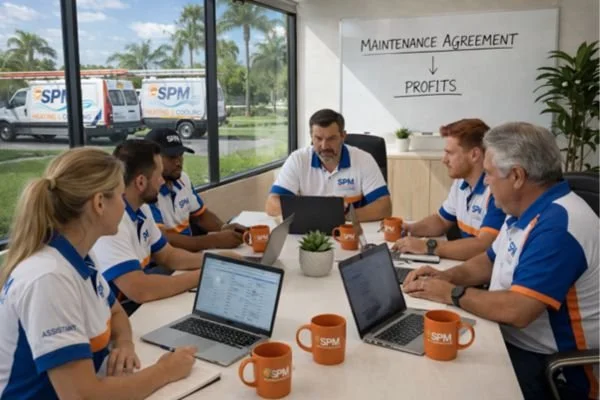
Do The Cost Pre‑Work First
There is no shortcut here.
Before the formula can work, the actual yearly cost to serve one agreement must be known.
Build your yearly fulfillment cost from these parts:
Technician labor with full burden: hourly wage plus payroll taxes, benefits, and paid time off.
Overhead allocation: the agreement’s share of office payroll, rent, insurance, software, phones, dispatch, management, and admin support.
Materials and consumables: filters, small parts, and anything included in the visit.
Admin and billing: scheduling, reminders, processing, and customer communication.
Callback and complexity buffer: extra time for visits that run long, extra communication, and follow‑up on equipment or customers that are not simple.
Here is a simple example. Two visits per year.
Labor with burden: $95
Overhead allocation: $60
Materials and consumables: $20
Admin and billing: $15
Callback and extra time buffer: $20
Total yearly fulfillment cost: $210
Apply a 20% net profit target:
$210 ÷ (1 − 0.20) = $210 ÷ 0.80 = $262.50 (round up).
Minimum realistic price: $263 per year.
One critical item many contractors miss is non‑billable time.
Technicians do not bill every hour they work. Drive time, shop time, callbacks, training, and downtime all cost money.
Agreement pricing has to help carry those hours, not just the time on site.
Gross Margin Is Not The Goal
Gross margin only measures the spread between the selling price and direct field cost. It does not pay for office payroll, dispatch, software, management, training, insurance, or billing. A maintenance agreement can show a strong gross margin yet still fail to improve net profit once all real costs are accounted for.
Net profit is the real scorecard. It shows whether the agreement is actually strengthening the business after everything is paid.
If an agreement looks healthy at the gross margin level but does not improve net profit, it is priced wrong. That is the benchmark.
Stop Building Price From Competitor Rates
Competitor pricing feels like market awareness. It is not a pricing system.
There are two problems with starting there.
First, the competitor may already be underpriced. Matching that number does not create an edge. It just repeats someone else’s mistake.
Second, even if that price works for another company, it may not work for yours.
Their labor burden is different. Their overhead is different. Their drive times, service areas, and technician efficiency vary.
The same plan price can produce completely different results in two different businesses.
Use the market as a reference point after completing the internal pricing calculations.
The company’s own numbers come first. The target net profit comes next.
Then the market can be reviewed to decide how to position and explain the value.
When that order is reversed, the result is often a plan that looks competitive but also drains profits.

Build the 3 Maintenance Agreement Tiers With Intention
Tiers are not just about giving homeowners choices. Tiers control the program's economics.
Bronze: The Entry Tier
Bronze creates access for price‑sensitive homeowners. It should cover basic preventive maintenance and core member benefits.
The risk is loading it with too much labor or too many discounts. When that happens, Bronze becomes the least profitable tier, and too many customers choose it.
Silver: The Economic Engine
Silver is the plan that should carry the financial weight. In most companies, it is the most commonly chosen plan. That means it needs to produce the strongest net profit contribution by design.
Price Silver with discipline. Control what is included. Do not give away margin just to make it feel like a bargain. The goal is a fair, clearly communicated offer that also protects the company.
Gold: The Premium Anchor
Gold creates a higher‑value experience for homeowners who want more convenience, faster response, or richer benefits.
Premium pricing only works when the premium scope is controlled. Too much open‑ended labor, too many free visits, or too many uncapped promises turn Gold into a profit leak.
The point of tiering is not variety. It is structured pricing with a known cost and known net profit target at every level.
Check Your Field Service Platform Settings
Once the pricing is right on paper, the work is not done.
The settings in your field service software platform (FSM) need to match the math.
Pricing tools in systems such as ServiceTitan and Housecall Pro allow you to build flat‑rate pricing from your costs and a target gross margin.
They also give you options about how profit is added to cost.
If those settings rely on markup rather than true margin logic, or if cost inputs are weak, the software will repeat that mistake across every job and agreement.
For companies using ServiceTitan, review the pricing rules for maintenance items in the pricebook.
Confirm that the rules are using a gross margin target and that your labor and material costs are current.
For companies using Housecall Pro, review the flat‑rate pricing screens and focus on the gross margin rather than the markup percentage. The profit you keep is tied to that margin result, not to a markup label.
The main point is simple.
The system will do exactly what it is told to do. If cost data and margin targets are right, it can support profitable agreements.
If the inputs or settings are wrong, it will scale the mistake.
Review Pricing Every Year
Maintenance agreement pricing should not stay frozen.
Labor, benefits, insurance, software, fuel, and supplier costs all move. The agreement that protected profit two years ago is almost never protecting the same profit today.
Many contractors avoid price increases because they worry about pushback. That delay is expensive. By the time weak pricing becomes clear in the financials, the damage has been happening for months or years.
A better habit is simple:
Review real fulfillment cost every year.
Re‑run the net profit formula.
Adjust pricing when profit protection has slipped.
The question is not whether prices should go up every year. The question is whether the current price still protects the net profit target. If it does not, the price needs to change.

Track Net Profit By Tier, Not Just Enrollment
A maintenance program is not successful because many agreements were sold.
It is successful because it strengthens the company.
That means results need to be tracked by tier, not just in total:
Renewal rate by plan.
Average fulfillment cost by plan.
Callback rate by plan.
Net profit contribution by plan after overhead and support costs are included.
Enrollment numbers matter, but they are not the finish line. Gross margin can still be watched as an early warning signal, but net profit is the real measure.
Repair revenue, accessory sales, additional systems, and replacement leads can all add upside. Those gains should sit on top of an already profitable agreement model, not be used to justify weak base pricing.
Key Takeaways
Price maintenance agreements for net profit, not just gross margin.
Use your own numbers before looking at competitor pricing.
Include labor burden, overhead, admin, materials, callbacks, and non‑billable time in the cost.
Design the middle tier to carry the strongest net profit contribution.
Review pricing every year and adjust when profit protection slips.
Track performance by tier to see which plans are really helping the business.
Frequently Asked Questions
Should maintenance agreement pricing be based on competitor pricing?
Maintenance agreements often lose money because of inconsistent field execution. When technicians perform visits inconsistently, labor time increases, and inspection steps may be skipped. Over time, these inefficiencies reduce the maintenance program's profitability.
Is gross margin enough to know whether the plan is working?
No. Gross margin shows whether direct costs are covered. Net profit shows whether the agreement helps the business after overhead, admin, callbacks, and non‑billable time are absorbed.
Which tier usually delivers the best financial results?
Usually, the middle tier. Silver is often the most chosen plan, so it should be designed to create the strongest net profit contribution.
How often should maintenance agreement pricing be reviewed?
Every year. In most companies, prices should rise over time to keep pace with labor, overhead, supplier costs, and service performance.
Does monthly versus annual billing change whether an agreement is profitable?
No. Annual billing helps cash flow. Monthly billing can help conversion. Neither one fixes underpricing. The math has to work either way.
Stop Letting Chaos Set Your Prices
If your schedule is full but your bank account does not reflect it, your maintenance agreements are not working the way you think they are.
This is where most HVAC owners get it wrong.
You do not have a maintenance agreement problem. You have a pricing problem that is quietly draining profit every single day.
Book a free strategy session.
I will show you exactly where your maintenance agreements are leaking profit and what it takes to fix it.
Coach Ellie is an award-winning certified business and executive coach helping HVAC, Plumbing, and Electric business owners across the Northeast, Mid-Atlantic, and nationwide scale profits, strengthen leadership, and streamline operations through no-fluff strategies that actually work.