HVAC Technician Vacancy Crisis: Owners Must Lead & Align
Stop the Chaos: Book a Free 20-Minute Strategy Call
If leadership gaps are costing you 20% in lost capacity, it’s time to align your team.I help HVAC owners fix operational chaos and protect profit margins.
Click here to grab 20 minutes on my calendar to get a clear plan to organize your business.
Table of Content
HVAC Technician Vacancy Crisis: Owners Must Lead & Align
HVAC technician vacancy is projected to remain high for years to come.
The U.S. Bureau of Labor Statistics projects approximately 40,100 openings for HVAC technicians each year through 2034, with employment expected to grow 8% over the decade.
Even with this strong demand, HVAC companies across the United States face an ongoing workforce crisis that threatens their ability to serve customers and stay profitable.
The problem is not just finding technicians to fill open jobs.
There is an important, deeper issue that many owners do not discuss.
In my 25+ years as a trades business and executive coach, I’ve noticed a recurring pattern. Leadership misalignment at the top and daily workforce chaos on the front lines quietly drain productivity and profit across the entire company.
Research shows that median productivity losses can reach 25% when supervisors or managers are spread too thin and forced into reactive "firefighting" mode.
ServiceTitan states that HVAC technicians often spend about 2 hours a day on tasks that do not generate revenue for the company.
Instead of fixing air conditioners, they spend 25% of their time driving around to find parts or dealing with confusing schedules.
For a 15-person HVAC team, this "wasted time" can add up to a loss of more than $1 million every single year.
The Real Numbers Behind the HVAC Workforce Crisis
HVAC technician vacancy rates are at critical levels.
The industry currently needs approximately 110,000 more workers than it employs to meet normal capacity. Many companies cannot find enough trained workers to meet demand.
Part of the problem is age.
Many experienced technicians are approaching retirement, while too few young people are entering the field.
This shortage is driven by a "retirement cliff" where five experienced technicians retire for every two new workers entering the field, leaving over 50% of the current workforce over age 45.
Another problem is how work gets managed.
Many HVAC companies report that poor planning and communication breakdowns reduce productivity, making the labor shortage feel even worse than it already is.
Unclear schedules and poorly defined responsibilities cause technicians to lose productive time that should be spent serving customers.
Surveys show that 45% of contractors report that poor planning and communication breakdowns are actively destroying labor productivity.
The Hidden Productivity Drain: What Leadership Misalignment Really Costs
Many HVAC owners focus on hiring but miss a bigger problem inside their business.
Productivity losses often come from poor planning and weak leadership, not from a lack of people.
Construction and trade research shows that companies lose a large share of their work capacity due to avoidable inefficiencies.
The Mechanical Contractors Association of America identifies 16 common factors that reduce labor productivity in construction-related trades.
These include:
Trade stacking
Dilution of supervision
Manpower reassignment
Working out of sequence
Poor planning.
Construction management research shows that a lack of supervision and poor material planning are major causes of wasted labor.
When supervisors are spread too thin, they cannot properly guide the work. They are forced to react to problems rather than plan.
Technicians end up waiting for answers, guessing what to do, or redoing the same work.
When there is no clear direction on the job, work slows down and productivity drops.
Weak leadership creates confusion about who is directing the work.
The Toxic Leadership Factor: Why Your Best People Leave
The technician shortage conversation often overlooks one of the most important factors affecting retention.
Leadership behavior plays a direct role in whether skilled technicians stay or leave.
When leadership becomes unhealthy, technicians burn out faster, lose motivation, and begin searching for other opportunities. This happens even in companies that offer competitive pay.
Poor leadership creates daily job stress.
Technicians working under toxic leadership experience higher frustration, mental fatigue, and emotional exhaustion.
Over time, they disengage from their work, lose trust in management, and feel disconnected from the company’s goals. Once this disengagement sets in, turnover becomes likely.
Burnout usually appears before resignation.
Technicians first check out mentally.
They contribute less, avoid responsibility, and stop offering ideas or solutions.
After disengagement takes hold, they quietly plan their exit. This pattern explains why technician turnover often feels sudden, even though the warning signs have been present for months.
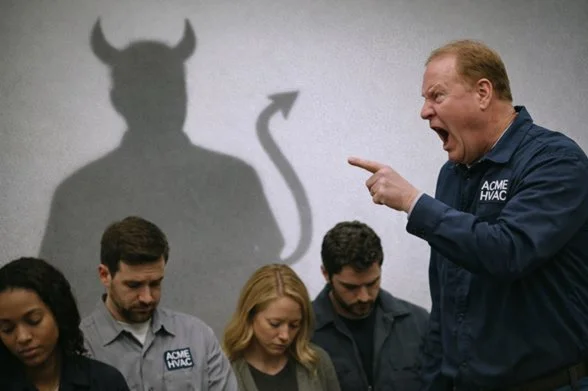
This dynamic is especially damaging in HVAC companies where owners lead from fear.
Concerned that losing even one technician will disrupt operations, owners avoid accountability and tolerate poor behavior.
Standards slip. High-performing technicians feel overlooked, while low performers face no consequences. The work environment becomes frustrating and unfair.
The outcome is predictable.
Skilled technicians leave for companies with stronger leadership, clearer expectations, and better direction.
What remains is a team with lower skill levels, weaker motivation, and more problems to manage.
Leadership quality is not a soft issue. It directly affects technician retention, workforce productivity, and long-term HVAC business performance.
HVAC Technician Vacancy and the Compounding Effect of Leadership Chaos
Research shows that poor supervision and weak planning are major drivers of productivity loss in construction and trade businesses.
Recent studies confirm that supervision quality and communication are among the most influential factors affecting labor productivity.
When supervisors lack the time, tools, or clarity to guide the work properly, productivity drops quickly across the jobsite.
Missed supervision often occurs when instructions change without accounting for planned task durations, such as moving technicians before work is completed.
Technicians receive mixed signals, priorities shift without explanation, and work slows as teams wait for direction or correct avoidable mistakes.
This lack of consistent supervision creates inefficiencies that spread beyond a single job.
Confusion replaces momentum, rework increases, and delays compound across schedules.
Competent supervision and effective communication are critical to maintaining productivity and preventing these disruptions on a job.
HVAC Technician Retention Solutions Begin With Leadership Alignment
Leadership alignment is a primary driver of financial performance and organizational efficiency.
Research from McKinsey indicates that companies with highly aligned leadership teams are 2x as likely to deliver above-average financial results.
Alignment in an HVAC company is not just a “nice to have” idea.
It is one of the main reasons why some businesses run smoothly, keep techs long term, and hit their numbers, while others stay stuck in chaos, burnout, and turnover.
What Leadership Alignment Really Means
Leadership alignment means the owner, managers, and team share a clear picture of success and act on it every day.
In a healthy HVAC company, they do not send different or confusing messages about what matters, such as sales, quality, or customer care.
When leaders and the company are truly aligned:
Everyone agrees on the main goals, like revenue, profit, call count, and callback rate.
Those goals do not change every week because someone got upset or excited about a new idea.
Daily choices match the long‑term plan, instead of chasing whatever feels urgent in the moment.
Studies also show that companies with strong alignment between vision, strategy, and daily actions grow faster and are more profitable than those without it.
In an HVAC business, that shows up as smoother days, better customer reviews, and fewer “fire drills” for the field.
Why Alignment Must Start With the Owner
Alignment begins at the very top.
The owner is the only person who can clearly set the company’s financial targets, service priorities, and capacity limits.
Many HVAC owners hire an experienced trades business coach to help them navigate this step.
If the owner is not steady, no one else can be steady either.
Owners need to decide:
What profit margin must the company hit to stay healthy?
Which services are most important (for example, maintenance agreements versus one‑off emergencies)?
How many jobs can the team handle in a day or week without burning people out?
Problems arise in a company when an owner:
Often changes direction
Chases every new “opportunity.”
Reacts emotionally or irrationally to daily problems
Is unclear or inconsistent
This instability will flow straight down the line to the team members. If the owner is unsure and stressed, the team will feel the same.
The team experiences:
Schedules that swing from empty to overloaded.
Changing rules about discounts, callbacks, or pricing.
Managers and techs never quite know what “good enough” means.
This results in lower team engagement and higher turnover within the company.
The Recruiting Advantage of Strong Operations
One of the least discussed truths about the HVAC technician vacancy crisis is that strong operations reduce the need for constant recruiting.
Companies with aligned leadership and stable daily execution do not struggle to attract technicians at the same level as chaotic businesses.
When technicians can complete their work efficiently, earn consistently, and trust management decisions, they are far more likely to stay.
In the trades, reputation matters.
Technicians talk to each other at supply houses, training events, and online forums. They compare more than wages.
They talk about whether schedules make sense, whether dispatch creates problems or solves them, and whether leadership has a clear plan.
HVAC companies known for organization and consistency attract better candidates without relying heavily on sign-on bonuses or inflated hourly rates.
Operational discipline also protects loyalty.
When technicians feel respected and supported, they are less tempted to leave for a small pay increase elsewhere.
Over time, this stability compounds. Training investments pay off. Skill levels rise.
Teams become more efficient.
Recruiting becomes easier because the business no longer has to replace people who have burned out or left due to frustration.
Measuring Success Through Productivity and Profit, Not Headcount
The most effective way to measure progress in a tight labor market is not by counting how many technicians you have, but by measuring how well your current team performs.
Productivity metrics provide a clearer picture of leadership effectiveness than open positions ever will.
What an HVAC business owner needs to measure:
Billable hours per technician
First-time fix rates
Callback volume
Schedule adherence
Gross margin by service
Customer satisfaction
When supervision improves and planning stabilizes, these numbers trend upward. When leadership slips back into reactive mode, they decline quickly.
Many HVAC companies are already losing between 20-25% of their available capacity due to wasted time, rework, and poor coordination.
Reclaiming that lost capacity can feel like having 4 technicians on a 20-person team without hiring anyone. This reclaimed productivity reduces pressure on schedules, improves customer satisfaction, and reduces technician burnout.
Strong Leadership and Alignment Determine Long-Term HVAC Success
The HVAC technician shortage is real and is not going away soon.
Demand for HVAC services continues to grow, the workforce is aging, and the pipeline of new technicians remains limited. But not all companies experience this shortage in the same way.
The businesses that succeed through this period are not the ones chasing talent the hardest.
They are the ones that fix leadership alignment, eliminate daily chaos, and create environments where technicians can do good work without constant disruption.
These companies retain skilled technicians longer, operate more efficiently, and protect profit even when labor markets tighten.
Leadership alignment is not a motivational exercise or a soft management concept. It is an operational discipline that determines how work flows through the business.
When leadership is steady, the company is steady. When leadership is reactive, the company stays stuck in survival mode.
The best technicians in your market are already employed.
The deciding factor in whether they stay with their current company or look elsewhere is simple: do they work for a company that respects their time, supports their success, and operates with clarity?
Leadership alignment is the foundation that makes those things possible.
Top Takeaways
The HVAC technician shortage is not just a hiring problem; it's a leadership alignment problem. Most companies lose 20–25% of their capacity due to poor planning, weak supervision, and reactive management. Fixing alignment can reclaim the equivalent output of four or five technicians on a 20-person team without hiring anyone new.
Toxic or unstable leadership drives technician turnover faster than low pay. When owners lead from fear, avoid accountability, or constantly change direction, skilled technicians disengage mentally before they resign. Strong operations and clear expectations create retention advantages that no sign-on bonus can match.
Productivity metrics reveal whether your leadership is working; headcount does not. Track billable hours per technician, first-time fix rates, callback volume, and schedule adherence. When these numbers improve, your leadership alignment is working. When they decline, chaos costs you capacity and profit.
Frequently Asked Questions
How do I know if my technicians are burnt out or just unmotivated?
Burnout shows up as disengagement before resignation. Watch for technicians who stop offering ideas, avoid responsibility, contribute less during meetings, or seem mentally checked out even when physically present. Unmotivated technicians often lack clarity about expectations or see no consequences for poor performance.
Both problems stem from weak leadership, but burnout requires immediate attention to prevent turnover.
What if I can't afford to lose even one technician right now? How can I hold people accountable?
Leading from fear of losing someone guarantees you will lose your best people. High performers leave when they see low performers face no consequences. Accountability does not mean being harsh. It means clear expectations, consistent follow-through, and fair outcomes.
Technicians respect owners who protect standards, not owners who tolerate chaos to avoid conflict.
We already track billable hours. What other productivity metrics should we measure?
Billable hours alone do not show operational health.
Add first-time fix rates to measure technician skill and training effectiveness. Track callback volume to identify quality issues. Monitor schedule adherence to reveal dispatch problems. Measure gross margin by service line to see which work is actually profitable. These metrics together show whether leadership alignment is improving or slipping.
How long does it take to see results after improving leadership alignment?
Most companies see measurable improvements in schedule stability and technician engagement within 30–60 days. Productivity metrics like billable hours and callback rates typically improve within 90 days. Retention improvements take longer, often six to 12 months, because rebuilding trust and changing company culture requires consistency over time.
What's the first step to fix leadership misalignment in my HVAC company?
Start by defining non-negotiable financial targets, service priorities, and capacity limits with your leadership team.
Get everyone on the same page about what success looks like and what trade-offs you will make when conflicts arise. Many HVAC owners work with an experienced trades business coach to facilitate this process and ensure accountability at the top.
Stop Losing Profit to Chaos: Reclaim Your Team's Capacity
You don’t need more technicians; you need your current team at full capacity.
Poor planning and mixed signals drain up to 25% of your productivity, leaving hundreds of thousands on the table every year.
I help $5M–$30M HVAC owners eliminate operational chaos and protect profit margins without hiring more techs.
Schedule a free 20-minute strategy call to identify the top 3 productivity drains in your business and get a clear action plan to fix them.
Meet Coach Ellie Marshall
Coach Ellie is a certified, award-winning business and executive coach specializing in service industries with $5M–$30M in revenue across the United States.
She works with HVAC, plumbing, and electrical professional services companies nationwide. Her no-fluff strategies solve operational chaos, build high-performing teams, and improve cash flow.