HVAC Pricing Options Are Broken: How to Move Forward

Table of Content
The pricing pressure hitting HVAC contractors right now is not a rumor, and it is not temporary.
It is math, and the numbers have deteriorated quickly.
Recently, ACCA confirmed what many contractors were already feeling. “Many Original Equipment Manufacturers (OEMs) have issued notices indicating the 50% tariff on covered steel, aluminum, and copper articles will be reflected in equipment pricing.”
In plain English, HVAC manufacturers are telling contractors they're passing these tariff costs on. Ouch.
Mexican-made HVACR equipment, which accounts for the largest share of U.S. imports, saw its effective tariff rate jump from roughly 8% to 25% after the U.S. origin metal exemption was eliminated.
Chinese-sourced compressors, motors, and control boards now carry a combined rate of 30% or more.
Moreover, a single piece of equipment can be subject to more than one tariff program at the same time. The cost structure changed fast, without asking permission.
ACCA reports an average truck operating cost of approximately $84.40 per hour before profit. An $89 charge leaves just $4.60 if the call consumes one full hour of truck time.
That is what happens when owners price from memory instead of from current math. In a market where the busy season is already compressing margins, not knowing is not protection.
It is exposure.
Equipment costs moved. Labor stayed expensive. Overhead kept climbing.
Yet many companies are still sending estimates based on outdated assumptions into a market that no longer supports them.
The result is not always a dramatic loss on one job. It is a slow, quiet erosion across hundreds of jobs while the owner wonders why the bank account never catches up to the revenue.
Why So Many Busy HVAC Companies Stay Broke
One of the most frustrating realities in HVAC is that a company can look healthy from the outside and still be deeply underperforming financially.
Trucks are moving.
The phone rings.
Installs are booked.
The team is busy.
Revenue looks decent.
Yet the owner still feels squeezed at month's end and exhausted at year's end.
ACCA's own educational materials make it clear this is common. Many contractors think they are making money because they see revenue and gross margin.
But when you include all costs, the true net profit is painfully small.
That disconnect happens because activity is easy to see, but profit is not.
A company can sell a lot of work and still under-earn on almost every hour it produces.
That is how owners end up working full-time, carrying full risk, and still taking home less than the business should be able to produce.
This is also why the phrase "busy but broke" resonates so strongly in this industry.
It captures the emotional reality of owners who do everything they were taught to do operationally, yet never achieve the financial outcome they expected.
The problem is not simply effort.
It is that effort that is being poured into pricing structures that were never truly designed around net profit.

The Net Profit Gap HVAC Owners Are Living With
ACCA says a healthy HVAC company should target a net profit margin of 10% to 12%.
Yet industry benchmarks show the average HVAC contractor nets closer to 5% to 6%.
Finance and industry data show that a “middle of the pack” HVAC contractor earns about 5.8% net profit, while some studies round the average up to about 8% net.
Put simply, many owners are working all year to keep only 6 to 8 cents of true profit from every dollar they bring in.
That gap is not about effort. It is about pricing that has not kept up with the cost base.
At ACCA's 2025 conference, Ruth King showed an HVAC owner that his true net profit was only $7.21 per hour, once all costs were accounted for.
That owner was busy billing, running his business, and doing what he always did. He just had no idea what he was actually keeping after all the costs were counted.
"Your true net profit per hour may shock you. Most owners think they are making money until they calculate what they are actually keeping after every cost is counted."
Ruth King, ACCA 2025 Conference
That is the gap. Not a bad quarter. Not one tough job.
A pricing system that looks like it is working until the real math shows up.
This gap matters because it drives every business decision.
Thin net profit means less room to hire, less room to market, and less room to absorb a mistake.
It means the owner cannot step away from the truck or stop putting out daily fires.
It also makes every price conversation feel personal and every slow week feel dangerous.
Healthy net profit creates options. Weak net profit creates pressure.
Right now, most HVAC owners are living much closer to the pressure side than they realize.
What Has Changed in the Last Two Years: The Cushion Is Gone
During the stronger demand environment that followed the pandemic, many companies could survive on momentum.
Calls were coming in.
Homeowners were spending.
Replacement demand stayed strong.
Even if pricing was inconsistent, the sheer volume of work covered up many flaws.
Since then, that cushion has vanished.
Equipment prices have continued to rise under pressure from materials, regulation, and tariff-driven cost stacking.
Legal filings in 2026 alleged that major manufacturers have pushed HVAC prices to historic levels after the pandemic, further adding to downstream pressure on contractors trying to hold margins.
At the same time, market commentary began describing a harsher environment in which revenue growth was no longer enough to mask weak profitability.

The Speed of Change Has Accelerated
Pricing and profit‑protection training across the industry has shifted to match a new reality.
Many programs now tell contractors to review pricebooks more often, update costs more aggressively, and actively protect margins because the environment is changing too fast for annual guesswork.
In plain English, yesterday’s loose pricing habits do not hold up well in today’s market.
Owners do not need another “just raise your prices” lecture.
That advice is way too shallow for the market they are actually experiencing.
What has changed is not only the cost base, but also the speed, complexity, and consequences of weak pricing discipline.
Today, owners need a clear framework they can govern, not vague nudges and hope.
What the Common Pricing Options Miss
The Method Is Not the Answer
HVAC owners are currently familiar with the following two HVAC Pricing Methods:
Flat rate.
Time and materials.
Not a pricing method, but a sales presentation strategy, the Good–Better–Best, or menu-style, presentation lets the customer choose the pricing option that works best for them.
The problem is not that these methods are wrong. The problem is that people often teach them as if the method itself is the answer.
It is not.
Each option solves only part of the problem.
Flat rate can improve consistency and customer communication, but it still fails if the underlying prices do not reflect actual labor burden, overhead, and profit requirements.
Time and materials can be appropriate for commercial work or open-ended service situations, but it still fails if labor rates are too low or parts markups are outdated.
What all of these methods miss, when taught in isolation, is the governing logic.
They do not answer the first question owners should ask: what net profit does this company need to produce?
Next question: what must each billable hour, service call, or install contribute to get there?
Without these answers, the pricing method is just packaging.
Where HVAC Pricing Breaks Between Cost and Price
Most pricing breakdowns happen in the same place: between the real internal cost of doing the work and the final number shown to the customer.
The business has real costs, whether the owner tracks them closely or not. Labor burden. Payroll taxes. Benefits. Trucks. Tools. Callbacks. Office salaries. Rent. Software. Insurance. Financing costs—owner management time.
Those costs do not disappear because they are inconvenient. They are the economic reality of the business.
Then the owner turns to pricing, and it's here that intuition often takes over.
The business owner thinks about
What feels fair.
What competitors might be charging.
What the customer may tolerate.
They may use a markup percentage or a flat-rate guide, but too often the number is still shaped by comfort instead of by economics.
ACCA's underpricing guidance makes the danger clear: the issue is not a lack of effort, but the failure to set prices based on the true cost of doing business.
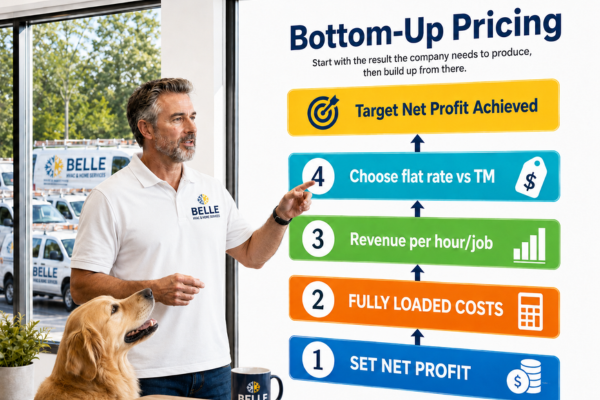
The Profitable Pricing Sequence For HVAC: Bottom-Up Pricing First
Most owners are taught to start with a pricing method and then try to make the numbers work.
A profitable pricing system does the opposite.
It starts at the bottom, with your net profit needs and the real cost of doing the work, and builds the price up from there.
This is why it is called bottom-up pricing.
Here is how it works:
Set the net profit your company has to produce to support you and your business.
Determine the fully loaded cost of operating your business, meaning direct labor and overhead.
Calculate your break-even rate per billable hour by dividing those costs by your billable hours.
Add your net profit target in dollars to your loaded costs, then divide by your billable hours. That is the rate each billable hour must bring in.
Price materials and equipment separately on each job, with their own markup.
Then decide which method, flat rate or time and materials, best delivers your net profit target.
This is very different from leading with a pricing method and hoping it lands on the right result.
How Everyday Decisions Quietly Drain Profit
Even when owners understand the basics, profit usually leaks out through small, repeated daily decisions.
A diagnostic fee that has not been updated in years.
A discount is given automatically just to avoid pushback.
A service agreement priced based on what sounds reasonable instead of what the work actually costs.
A pricebook set up once and never touched, while costs keep rising.
Each one feels minor.
But, together, they hollow out the business.
Low service prices can leave only a few dollars of real profit per hour after all costs are accounted for.
Vendor price changes, labor shifts, and rising overhead keep moving the target further down.
If an owner isn’t actively managing the numbers, the numbers start managing the owner.
Net profit per hour tells you whether your pricing is working. Owners who track it stop guessing and start managing.
This is why so many owners feel like they are always behind.
Their pricing does not collapse all at once.
It quietly decays in the background while the business keeps operating. By the time they feel the pain, the economic damage has been done.
Why New Pricing Tools Have Not Solved the Problem
Field service software has given HVAC contractors more control over their numbers by making the money side of the business visible in real time.
It lets owners track costs, prices, and margins by job, technician, and service type, instead of guessing from the end-of-month checkbook.
Many systems now include stronger pricebooks, cleaner quoting, better inventory tracking, and links to vendor catalogs or equipment records.
Those features are real improvements.
But software does not replace a clear pricing strategy. This is where many owners get disappointed.
They expect the software to “fix” pricing.
In reality, it can only support the pricing system the owner sets.
Some platforms can automate cost updates, link parts to catalog data or manufacturer records, speed up pricebook changes, and keep items more current.
But the final price shown to the customer still depends on owner‑controlled rules, markup logic, overhead recovery, and profit targets.
There is also a data problem. Many companies do not keep their numbers clean.
Costs are not updated,
Labor rates lag behind reality,
Items are coded in the wrong place, and
Old prices stay in the system.
When inputs are incorrect or incomplete, even the best software produces bad results.
I call this a “garbage in, garbage out " number.
The tool did its job; the setup and discipline did not.
That is why judgment still matters.
What Software Can and Cannot Do
If software changed customer prices every morning based solely on vendor feeds, it would be adjusting numbers without understanding the business.
It would not know your labor burden, warranty exposure, positioning, service model, or net profit target.
Automatic cost updates can be useful because they keep your inputs closer to reality.
Whether an owner uses a large enterprise platform or a simple system, the principle is the same: the software should support accurate cost maintenance, consistent categories, and disciplined pricing rules.
It should never replace the owner’s judgment about margin and net profit. Automatic pricing without owner judgment would be dangerous.
The Practical Way to Move Forward
Use the Bottom‑Up Pricing Method to set prices that actually support your HVAC business by starting with net profit and building your numbers from the ground up.
Start by deciding how much net profit you want the business to make in a year.
Do not start with gross margin. Do not start with what the market “feels” like. Do not start with what another contractor said at a conference.
Start with a clear net profit target and write it down.
Next, lay out your costs:
List your direct labor costs for field technicians, including wages, taxes, benefits, and payroll burden.
List your material and equipment costs.
List your overhead costs, such as office staff, rent, trucks, fuel, insurance, software, marketing, and your own management time.
Then decide how many billable technician hours you realistically expect in a year.
Billable hours are the hours techs spend on work you can charge a customer for, not meetings, training, shop time, or other non‑billable time.
Divide your total costs and net profit target by your billable hours.
That gives you the revenue each billable hour must generate.
Once you know what each billable hour has to bring in, use that number to set prices:
For a service call, estimate the actual billable hours and multiply by your required rate per hour.
For a typical install, estimate the total billable hours for the job, multiply them, then add parts and equipment, and check that you are still hitting your net profit target.
After this, the math is done, choose which of the two methods fits each kind of work. There are only two: flat rate and time and materials.
Residential service- typically flat‑rate. The homeowner gets one clear price, and you get consistency.
Residential installs- typically flat rate, often presented as Good, Better, Best options.Good, Better, Best is not a separate pricing method. It is simply flat rate presented as multiple choices.
Commercial service- time-and-materials is the most common fit because the scope is less predictable, though many contractors use flat rate for standard diagnostic and repair calls.
Large commercial projects- time-and-materials, usually with detailed job costing, since each project has a different scope.
Here is the rule that keeps this from getting messy: one job, one method.
Don't flat-rate half a job and bill hourly for the rest. Pick the method that fits that kind of work, and price the whole job that way, every time.
The main point is simple: Use Bottom Up Pricing to establish your required net profit and your required revenue per billable hour. Then choose the pricing method that best fits the work.
Key Takeaways
Busy isn’t the same as profitable: A full board and nonstop calls can still yield weak net profit if your prices are not based on real costs and realistic billable technician hours.
Bottom-Up Pricing starts with net profit: Decide what net profit the business needs for the year, then work backward through costs and billable technician hours to set prices that can actually support that target.
Billable technician hours cover everything: Only the hours techs spend on billable work are billable; office staff and overhead are not billable and must be covered by those field hours.
Pricing methods are just wrappers: Flat rate, time and materials, and Good–Better–Best all sit on top of the same math, and none of them will work if the underlying costs and profit target are wrong.
Net profit tells you if pricing works: If your company stays busy but net profit is still thin, your current prices are not recovering enough to cover overhead and hit the profit target, and something in your costs, hours, or prices has to change.
FAQ
Q. Are HVAC pricing options actually broken, or are they just incomplete?
They are often incomplete first and broken in practice second. Flat rate, time-and-materials, and good-better-best can all work in the right context. They break down when owners treat them as stand-alone answers rather than as methods inside a profit‑driven system.
Q. What is the first move an owner should make?
Start with the target net profit and real loaded costs. Without that foundation, every pricing decision is made on a fuzzy set of assumptions, and no method can fix that from the outside.
Q. Do tariffs really affect my pricing that much?
Yes. If you are buying equipment made in Mexico, China, or using components sourced from Canada, your cost base has shifted significantly. An effective tariff jump from 8 percent to 25 percent on Mexican-made equipment alone changes what every install needs to recover just to break even.
Q. Do all FSM platforms handle pricing the same way?
No. Some are stronger in pricebook management, some in catalog integration, and some in quoting workflows. But across all platforms, the principle is the same. The system can help maintain inputs and consistency, but the owner still has to control the pricing logic and profit targets.
Q. Should prices update automatically from manufacturers?
Cost inputs can be updated automatically or semi-automatically in some systems. But final selling prices should still be guided by the owner's rules and strategy. Blind automation is risky because cost is only one part of pricing. Your labor burden, warranty exposure, positioning, and profit target all matter too.
Q. What is the single biggest thing HVAC pricing options miss?
They usually do not start with the target net profit and loaded cost recovery. They focus on the method before the economics, and that is exactly backward from how a healthy pricing system is built.
Q. How should an owner think about moving forward?
Use a single core of logic and multiple methods. Start with net profit and real costs, then apply the most practical pricing model by segment, whether that is residential service, residential install, commercial service, or commercial project work.
Q.What should the owner be watching most closely?
Net profit per hour is supported by strong cost visibility and disciplined price review. That is the clearest signal that the pricing system is actually working and not just producing revenue, but producing the profit the business was built to earn.
Is Your HVAC Pricing Stressing Your Business?
If your phones keep ringing, your techs are exhausted, and you still don’t see the net profit you should,you have a pricing problem.
Take the HVAC Profit Stress Test to see if your current prices can actually support the business you’re working so hard to run.