How to Price HVAC Jobs So Every Department Turns a Profit

Table of Content
As of 2026, the average HVAC company nets only 5% to 10% in profit, with 5% being typical and only top performers reaching 15%.
Every HVAC owner wants to close that gap and keep more net profit. That’s a given.
As you know, working on your pricing is, of course, extremely important, and pricing pressure hits contractors every day.
That’s just half the battle.
But you also have to measure profit by Trade: HVAC, Plumbing, etc., and then by Department: Service, Install, Maintenance.
If you do not, you are just guessing which part of the business needs fixing.
Your service work might be strong, while installs barely break even.
A large commercial project might bring in impressive revenue and almost no profit.
One profitable piece of the company can carry a losing piece for years without anyone noticing.
So, how do you fix this expensive problem and learn what is holding your company back?
Why One Consolidated Net Profit Number Lies to You
When you look at any HVAC or plumbing company running at a 13% net profit, you see a financially healthy company.
On paper, it seems healthy. The owner is happy.
But that 13% profit number sits at the bottom of your monthly, quarterly, or yearly P&L.
It is a consolidated number, a single figure that combines every department, trade, and job type into one total.
That number masks the more important story: exactly where am I making profit, and where am I losing it?
To increase profit, stop reading the bottom of your P&L and start reading the different departments within your company.
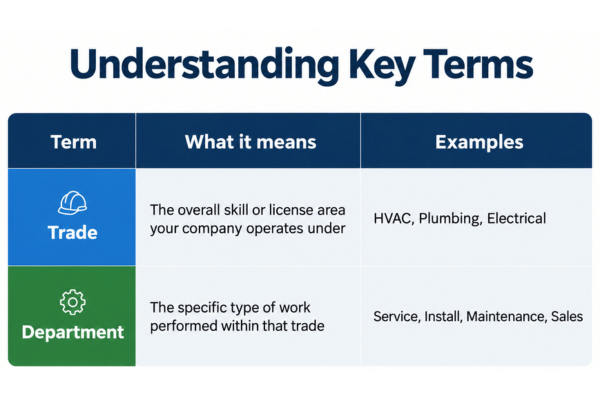
Trade and Department, Defined
Two terms, and nothing more. A trade is the license area your company works under.
A division is the type of work performed inside that trade.
A single-trade HVAC company has one trade, HVAC, with divisions for Service, Installation, Maintenance, and Sales.
A multi-trade company repeats the same division structure under each trade it runs.
A plumbing and HVAC company would have an HVAC trade with its own Service, Installation, Maintenance, and Sales divisions, plus a separate Plumbing trade with the same four divisions.
Once you lock in these two terms, every number and price you read is measured against a trade and a division, never against the whole company as a single blended figure.
Read the Profit and Loss Across, Not Down
A normal P&L statement is built to be read vertically, top to bottom.
That view cannot separate a service call from an install.
So you turn the statement sideways, horizontally.
Give every department its own column, and read each line across: materials, labor, gross profit, overhead, one department at a time.
Now each department stands on its own, and a department that is bleeding money has nowhere to hide inside the consolidated total.
Put Every Line in Percentages
Here is the move that makes it click. Convert every line to a percentage (%) of that department's own revenue.
The reason is simple.
The brain compares far better than it calculates.
Raw dollars force you to hold different-sized numbers in your head and do the math before you can judge anything.
Percentages put every department on the same scale so that you can see each one's shape at a glance.
One caution: Percentages show health, not size.
A tiny department with 20% net profit can matter less than a large one with 8%.
So read the percentage first to judge how a department runs, then check the dollars to weigh how much it moves the business.
Give the Front Office Its Fair Share
One honest step most owners skip.
The shared office costs:
The front desk
Admin time
Rent
Electricity
Heat
Software expenses, etc.
These real-world expenses usually sit in one general and administrative bucket off to the side.
If you leave it there, every department looks better than it really is, because none of them is carrying the office.
The solution: spread those office costs across the departments. This is called overhead allocation, and it is not a trick.
It is how a real departmentalized statement is built.
The easy way to start is by revenue share.
If installs account for 46% of revenue, they absorb 46% of the office costs.
Simple and good enough to see the picture. For the accurate version, allocate by each department's share of labor instead, because labor drives office and admin load more than ticket size does.
Start with revenue share to learn it. Move to labor share to trust it.
What This Looks Like on a Real Statement
Here is one month, read across by trade and department. The first row is each department's share of total revenue.
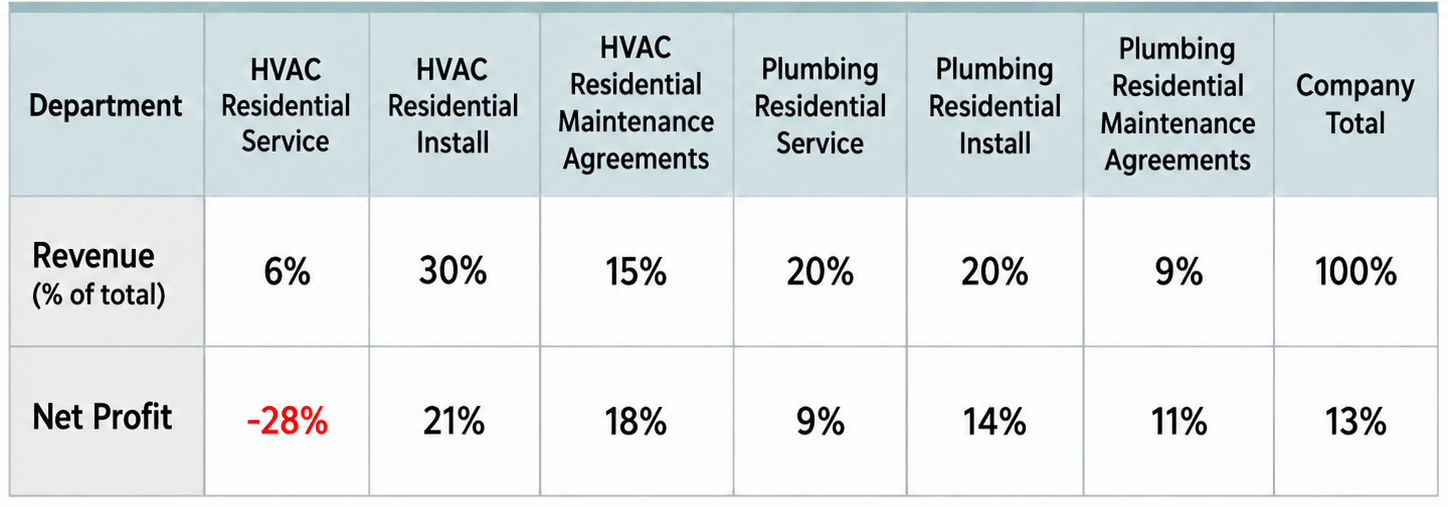
The company total shows 13% net profit, which looks fine, but when you look at it by trade and department, the picture changes completely.
HVAC Install and HVAC Maintenance Agreements are strong, while HVAC Service is performing poorly and dragging profits down.
Note: Only the Revenue row will sum to 100%.
Net Profit is each department's own number and is never meant to add up across the row. It just shows you which departments are healthy and which ones need attention.
Follow the One Department That Is Losing Money
Stay on HVAC Residential Service, because it is the whole lesson in one column.
It sells work, books calls, and, next to the rest of the business, looks like a normal part of the company.
If you only ever saw the consolidated statement, you would never suspect a thing.
That is exactly how a losing department survives for years: it hides behind a strong company total, and nobody looks.
The numbers say otherwise.
HVAC Residential Service accounts for just 6% of total revenue, the smallest share in the company, yet still ends the month at -28%.
Every other department is positive, from 9% up to 21%.
This department isn't just underperforming; it is actively pulling the company's total down, and the only reason the company still shows a healthy 13% is that five other departments are strong enough to absorb the loss.
That is the entire point of reading the business this way.
A department this small, losing this much money consistently, is invisible on a consolidated statement and impossible to miss once you split it out.
Now you know exactly where to look.
HVAC Residential Service needs more volume to spread costs. The rates do not cover the actual cost of sending a truck.
Maybe it should be folded into a department that already runs profitably.
Whatever the fix is, it was never visible while this loss sat buried inside a consolidated 13%.

When Departmentalizing Is Worth It
No revenue level is too small to start departmentalizing your business.
Every HVAC company, from one truck to fifty, should read its numbers by trade and department, not as one blended total.
The idea that you need to be a certain size first — five trucks, two million in revenue — before this matters gets it backward.
A one-truck shop that runs residential service in the morning and a residential install job in the afternoon still has two completely different cost structures sitting inside the same business.
If you never split them apart, you won't know which one is actually paying you and which one is quietly costing you.
Small does not mean simple.
It means the leak is smaller in dollars, not any less real.
The only thing that changes with size is how you tag, not whether it is worth doing.
What matters is that from your very first month, every job gets properly assigned to the correct trade and department in your field service management software and your books.
Separate your direct costs from your office costs from day one.
Keep your true labor cost, wage plus the burden on it, sitting with the job, not buried in overhead.
Do that from the start, and departmentalizing never becomes a project; it just becomes reporting.
If you skip this important step and wait for a future date or a larger company to justify it, you will end up paying someone to rebuild years of tangled financial history.
Any size company, any revenue level: structure the books this way now and save time and money later.
How To Price HVAC Jobs Once You Know the Numbers
Now that you have uncovered which departments bleed and which carry your HVAC business in percentages, you can allocate your time and effort efficiently.
Pricing stops being a guess.
You can now confidently price each department on its own:
Real costs
Loaded labor
Overhead per billable hour
Profit target
Going forward, set your price for that department based on its true costs.
Start with the real labor cost. Add the overhead it should carry. Add the profit you want to make.
That gives you the price this department needs to charge, on its own, not the same number every other department uses.
Start with your worst department, fix its price, and check the numbers again next month. Then move to the next one.
Remember: never use a single blended rate for the whole company again.
Key Takeaways
One consolidated net profit number hides which department makes money and which loses it.
Measure profit by trade first, then by department, never as one blended figure.
Read the profit and loss broken down by trade and department, and express every line as a percentage, since the brain compares proportions far faster than raw dollars.
Spread the shared office cost across departments, revenue share to start, labor share for accuracy.
Set up your books by trade and department from day one, so scaling later means turning on a report rather than a three-year cleanup.
FAQ
Q. Do I need special software to do this?
No. If your field service management software tags jobs by department and your books use matching classes, the data is already there. A spreadsheet works to start.
Q. What if I only run one trade?
You still have departments. A single-trade HVAC company breaks into Install, Service, etc.; you read each one separately.
Q. How do I split the office cost fairly?
Start with revenue share; each department absorbs office costs in proportion to its revenue. For a more accurate picture, switch to labor share, since labor drives most office and admin load.
Q. How often should I look at this?
Regularly, not once a year. A monthly read by trade and department catches leaks while you can still fix them.